published
Layout-Oracle
Pretext-profile text-wrap simulator for cross-browser wrap-drift diffs.
Published Apr 4, 2026
- cross-browser
- css
- frontend
- typescript
- ui-testing
Objective
Find cross-browser wrap drift fast, without launching real browser sessions.
Rationale
This project grew out of learning work. I wanted to understand where browser text wrapping diverges, and I wanted a practical way to test those cases without spinning up full screenshot pipelines.
It also came from wanting to try Pretext, then push it into a focused QA tool. Using a vendored subset let me experiment with engine-profile behavior and expose differences in a controlled UI.
Tech Stack
- TypeScript
- Vite
- Vanilla DOM
- Vendored Pretext subset with engine-profile overrides
Links
- Repository: github.com/JacobThree/Layout-Oracle
- Live preview: jacobthree.github.io/Layout-Oracle
Architecture
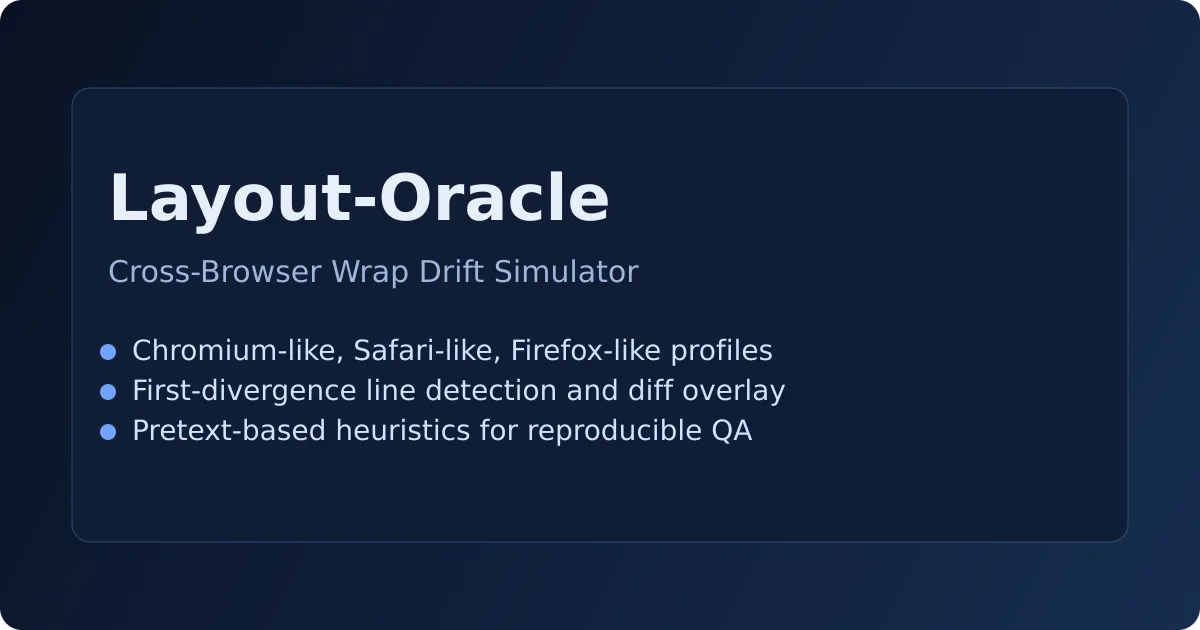
Layout-Oracle runs the same text through three modeled profiles: Chromium-like, Safari-like, and Firefox-like. It returns wrapped-line arrays for each profile and flags the first divergence index.
The diff view includes a line-index alignment overlay, so wrap drift is obvious at a glance.
Design choice was deliberate: keep model narrow, keep signal high. I only targeted wrap behavior and line-level drift, because that is where responsive regressions usually hide first.
Engine profile overrides expose these heuristic knobs:
lineFitEpsilonpreferPrefixWidthsForBreakableRunspreferEarlySoftHyphenBreakcarryCJKAfterClosingQuote
Execution
The workflow stays intentionally narrow:
- paste text
- choose width, font, line-height
- compare simulated wraps across engines
Built-in demo cases trigger modeled edge behavior for quick repro.
Results
This tool cut debugging time for line-wrap regressions and removed guesswork during responsive QA.
Boundary is explicit: this is a profile-based wrap simulator, not a full browser emulator.
As learning outcome, project sharpened my understanding of text layout mechanics, browser-fit heuristics, and how to design debugging tools around one clear question instead of broad platform scope.